
Slopes, swales and banks
Erosion Control Blankets & Hydromulch in Greensboro, NC
Holding red clay slopes in place until grass roots can do the job.
- No-charge visit to the property and an itemized quote in writing
- Seed mixes and timing matched to Piedmont clay and tall fescue season
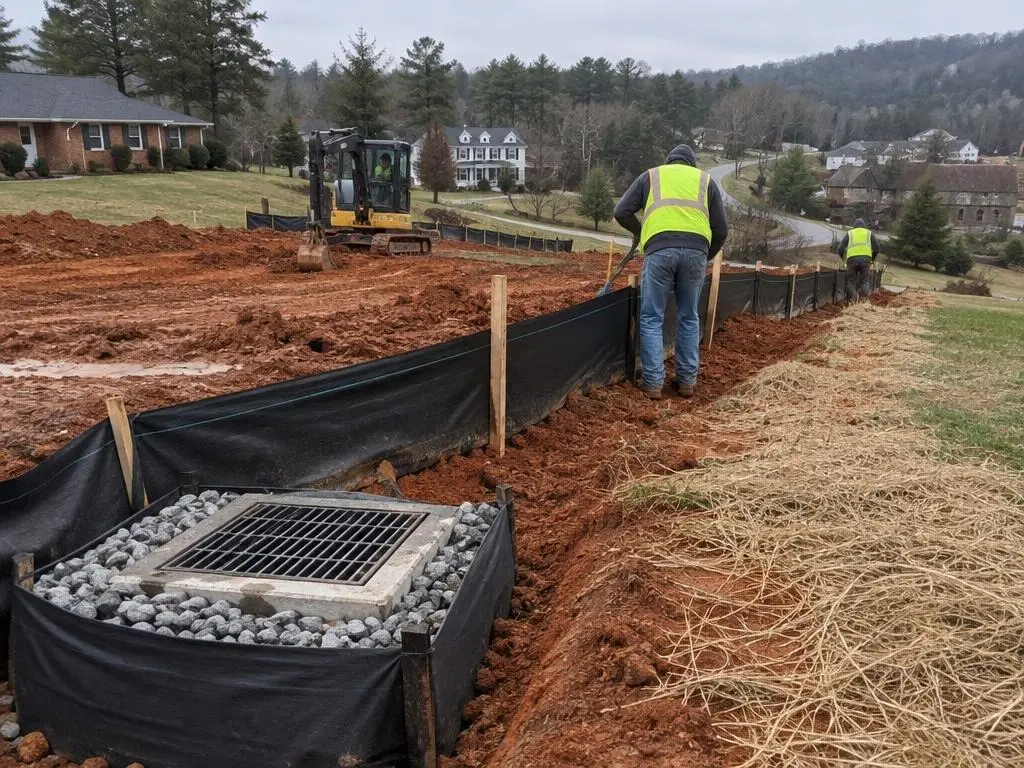
- Silt fence and seeding planned around the state's 21-day stabilization rule
Keeping Clay Slopes Where They Belong
Erosion control blankets and hydromulch are what we use in Greensboro when seed and a light mulch will not stay put: steep yard banks, driveway cuts, drainage swales, ditches and pond slopes. Red clay that has lost its topsoil sheds water fast, and the Piedmont's summer storms cut it into rills and gullies. These erosion control services give seed a protected, damp layer and keep the soil from moving until roots knit the slope together.
Why slopes fail here
The Cecil soil that covers most of the region is a thin sandy loam over red clay, and much of it lost its topsoil through erosion long before the houses went up. Once the clay is exposed on a slope, rain does not soak in; it runs. NC DEQ lists four types of erosion on exposed ground: splash, sheet, rill or gully, and stream or channel erosion. Every one of them shows up on Triad building lots. Sediment that leaves a slope ends up in streets, storm drains, creeks and neighbors' yards.
Hydromulch and bonded fiber matrix
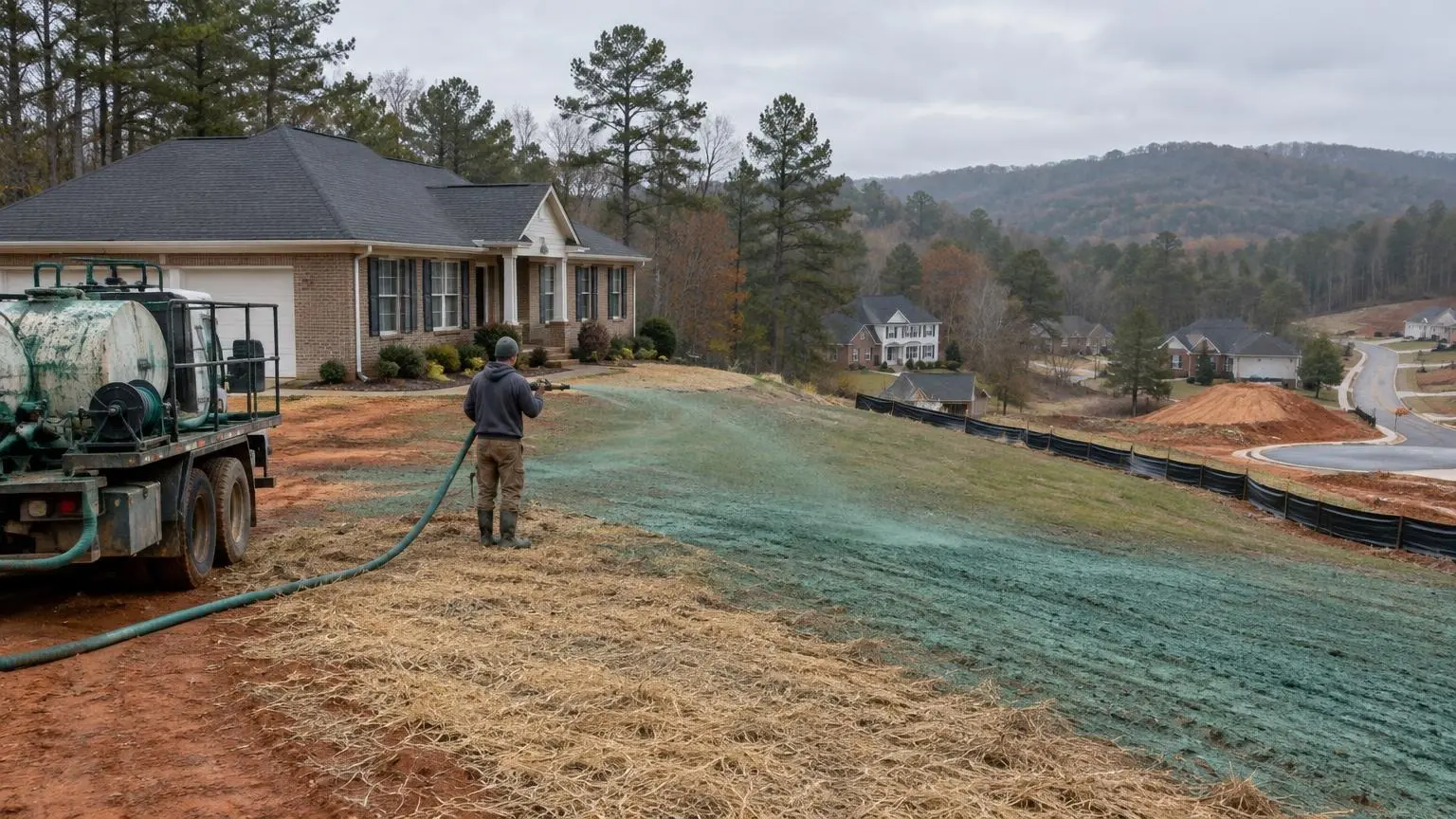
For moderate slopes, hydro mulching at a heavier rate is often enough. The wood fiber and tackifier form a mat over the seed that resists raindrop splash and holds moisture. Where a slope is too steep to walk comfortably, we spray bonded fiber matrix, a hydraulically applied mulch that dries into a continuous, bonded layer. It works on long cut banks and spots where blankets are hard to anchor.
Blankets
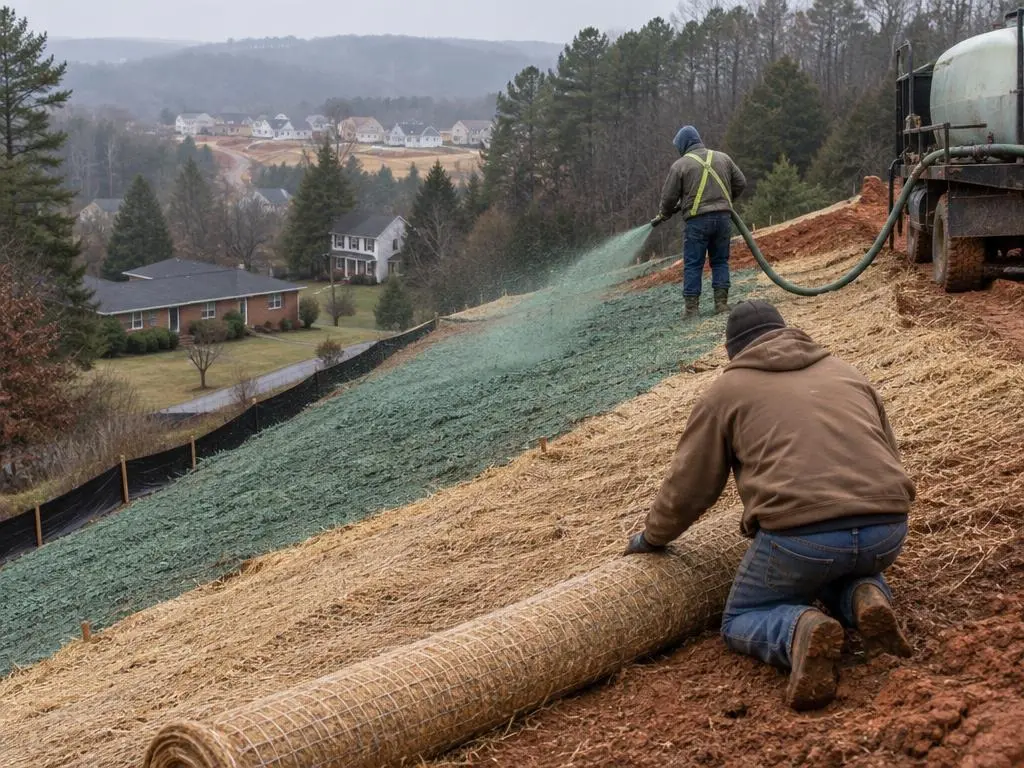
An erosion control blanket is a roll of straw, a straw and coconut fiber blend, or pure coir, pinned down over ground that has already been seeded. Straw blankets suit lighter slopes and short-term protection. Straw-coir and coir blankets last longer and hold up in swales and ditches where water concentrates. We seed and fertilize first, roll the blanket from the top of the slope down, bury the top edge in a trench, and staple it to the ground on a pattern tight enough for the grade.
Swales, ditches and pond banks
Channels carry concentrated water, which is a different problem from rain on a slope. NC DEQ's performance standard for construction sites is built around the 10-year storm, and it requires runoff velocity to be controlled so the receiving channel is not damaged. On residential and small commercial swales we use longer-lasting blankets in the flow line and hydromulch on the side slopes, and we point out if the channel needs riprap or regrading instead of seed.
Slope stabilization timing
On construction sites, the state requires graded slopes to be stabilized within 21 calendar days of finishing a phase of grading. Even outside a permitted project, a slope left bare through a Greensboro summer will lose soil every week. We try to cover slopes the same week they are shaped. In fall we seed tall fescue under the cover; in late spring and summer a warm-season or temporary mix may make more sense, followed by fescue in September. On rural banks and back slopes that will not be mowed, native grass seeding can be an option.
When it is more than erosion
If a slope is slumping, seeping water or steeper than soil can hold, seed and blankets alone will not fix it. We will tell you if the bank needs regrading, drainage or a wall first, and our grading crew can handle the dirt work where it fits our scope. Get a free estimate
Where sediment goes when a slope fails
NC DEQ explains why this matters beyond the yard. Sediment that leaves exposed ground builds up in lakes, streams and neighboring property, harms aquatic life, clouds the water, cuts the light that reaches aquatic plants, and fills in storm drains so they flood more easily. It also raises the cost of treating drinking water. Soil kept on a slope is soil that never reaches a creek, a lake or a storm drain. That is the practical reason erosion control contractors exist: covering bare ground costs far less than cleaning up after it.
Choosing between blanket types
The right blanket depends on how long the slope needs protection and how much water crosses it. Straw breaks down fastest and suits slopes where grass will establish within a season. Straw-coir blends last longer and handle steeper grades. Pure coir is the longest-lasting natural option and is our usual choice for channel bottoms. We explain the trade-off on the estimate.
Rural banks and native cover
On larger properties north and west of the city, many slopes are field edges, pond dams or long driveway cuts that nobody wants to mow. Those can be seeded with a lower-maintenance or native grass mix under the same blanket or mulch, so the bank ends up covered by plants that need little care once established. We plan the seed mix with how the slope will be used after the job.
Erosion Control Options
We match the cover to the slope, the flow and how long it needs to last.
Heavy-rate hydromulch
Wood fiber mulch and tackifier sprayed thicker for moderate slopes.
Bonded fiber matrix
Sprayed mulch that dries into a bonded layer on steep cut and fill banks.
Straw blankets
Seeded and stapled straw mats for slopes and short-term protection.
Straw-coir and coir blankets
Longer-lasting mats for swales, ditches and steeper banks.
Swale and ditch lining
Seed and blanket in the flow line, hydromulch on the sides.
Pond and basin slopes
Seed and cover on detention basin and farm pond banks.
Erosion Control Cost Ranges
| Item | Published rate |
|---|---|
| Sprayed wood-fiber mulch, each 1,000 square feet (state transportation department erosion rates, 2025) | $98 |
| 70% straw / 30% coconut blanket, each 1,000 square feet (state DOT unit-price list, 2025) | $468 |
| All-coir blanket, each 1,000 square feet (state DOT unit-price list, 2025) | $532 |
| Loose straw spread by hand, each 1,000 square feet (state DOT unit-price list, 2025) | $170 |
| Extra charge for seeding steep ground, per square foot (HomeGuide, 2025) | $0.05 to $0.10 |
Rate-schedule figures are a state transportation agency's reference prices, not Greensboro quotes. Bonded fiber matrix has no current published price we could verify, so we set that number once we have measured the slope. The total on your signed quote is the amount you pay.
How We Stabilize a Slope
1. Look at the water
We trace the water: where it enters the site, where it gathers and where it exits, before we choose a cover.
2. Shape and prep
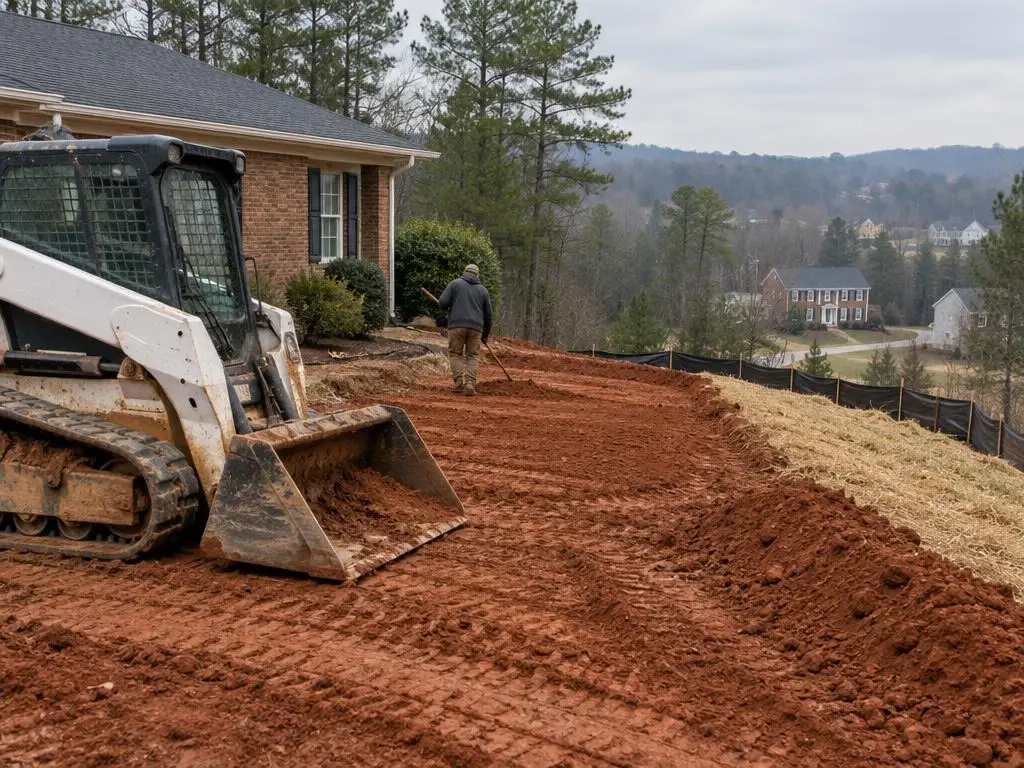
Smooth rills, loosen the surface and fix the grade where needed.
3. Seed
Seed and fertilizer go down first, matched to the season.
4. Cover
Hydromulch, bonded fiber matrix or blankets, anchored for the slope.
5. Follow up
After the first big storms we check for washouts and touch up.
Why Choose Us for Erosion Control Blankets & Hydromulch
Honest about limits
We tell you when a slope needs grading or drainage instead of more seed.
Several tools, not one
Mulch, bonded fiber matrix and three kinds of blanket, chosen by grade and flow.
Seeded under the cover
Every blanket and mulch job includes seed so the slope ends up held by roots.
Erosion Control Blankets & Hydromulch Questions
Blanket or hydromulch for my slope?
Moderate slopes with sheet flow usually do fine with heavy hydromulch. Steep banks, long slopes and any spot where water concentrates usually need a blanket or bonded fiber matrix.
Will someone have to pull up the blanket once the grass is in?
No. Straw and coir rot away on their own while the turf grows up through the fibers. Certain blankets are made with plastic netting, which we can avoid where wildlife or mowing is a concern.
Why does my clay bank keep washing out after I seed it?
Bare clay sheds water, and loose seed washes off before it roots. The slope needs a cover that holds seed and soil in place, and sometimes a change in where the water comes from.
Are erosion control contractors required on a home project?
Not always, but North Carolina requires erosion control for land-disturbing work regardless of size, and sediment must stay on the site. Bigger disturbances need an approved plan.
Erosion Control Blankets & Hydromulch Service Areas
- Hydroseeding in Greensboro, NC
- Hydroseeding in High Point, NC
- Hydroseeding in Summerfield, NC
- Hydroseeding in Oak Ridge, NC
- Hydroseeding in Stokesdale, NC
- Hydroseeding in Jamestown, NC
- Hydroseeding in Kernersville, NC
- Hydroseeding in Winston-Salem, NC
- Hydroseeding in Clemmons, NC
- Hydroseeding in Burlington, NC
- Hydroseeding in Graham, NC
- Hydroseeding in Gibsonville, NC
- Hydroseeding in Elon, NC
- Hydroseeding in Archdale, NC
- Hydroseeding in Thomasville, NC
- Hydroseeding in Lexington, NC
- Hydroseeding in Asheboro, NC
- Hydroseeding in Randleman, NC
- Hydroseeding in Reidsville, NC
- Hydroseeding in Eden, NC
- Hydroseeding in King, NC
- Hydroseeding in Bermuda Run, NC
Get an Erosion Control Blankets & Hydromulch Estimate
Free site visits for washing slopes, ditches and banks.